








Ticketing API Integration: Use Cases, Examples, Advantages and Best Practices
Learn the key concepts associated with Ticketing APIs and get started on your first Ticketing API integration.
Real, already-built Ticketing MCP Servers — give your AI agent access to every Ticketing platform Knit supports.
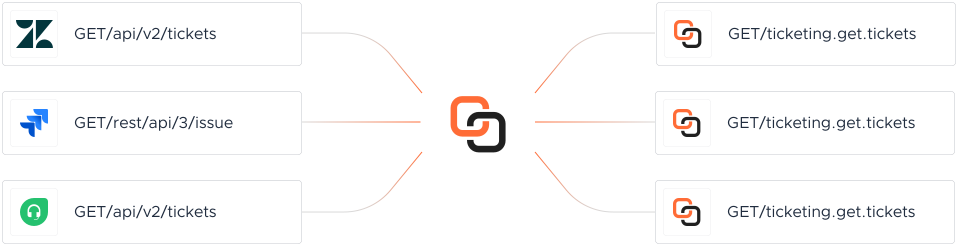
Each Ticketing platform exposes its own API, auth, and schema. A Knit MCP Server wraps that platform's real actions as AI-ready tools your agent can call directly — actions like Add Comments for a Ticket, Create Ticket, Get Account Details work the same way no matter which platform your agent is connected to, while Knit manages hosting, auth, and tool exposure underneath.
Every action below is real and already live — not a roadmap item. Browse the full API reference →
This API is used to add comments, conversations, or notes along with attachments for a particular ticket. The request body requires a 'ticketId' to specify the ticket for which the comment is being added. Optional fields include 'body' for the comment text, 'isPublic' to indicate if the comment is public, 'author' to specify the author of the comment, 'attachments' for any files to be attached, and 'metadata' for any additional fields. The response returns the 'id' of the newly created comment.
The Create Ticket API is used to create a new ticket in the system. It requires several parameters in the request body, including the ticket name, assigned user ID, creator user ID, due date, description, ticket type ID, account ID, project ID, group ID, contact IDs, priority, source, tags, and additional metadata. The request must include headers for content type and authorization. Upon successful creation, the API returns the ticket ID in the response body.
This API retrieves the details of a particular account or company in the system. It requires the account ID as a path parameter. The response includes the account ID, name, creation date, website, and industry.
This API retrieves the list of all comments, conversations, or notes along with attachments for a specific ticket. The request requires the 'ticketId' as a query parameter to identify the ticket for which comments are to be fetched. An optional 'cursor' parameter can be used for pagination. The response includes pagination details and an array of comments, each with details such as the comment ID, creation date, body, HTML formatted body, visibility status, author information, and any associated attachments.
This API retrieves the details of a particular contact or person in the system using their contact ID. The request requires the contact ID as a path parameter. The response includes the contact's ID, name, creation date, email address, phone number, and the account ID to which the contact belongs.
This API retrieves a list of all accounts or companies in the system. It supports pagination through the use of a 'cursor' query parameter. The response includes pagination information with 'next' and 'previous' cursors, and a list of accounts, each containing details such as 'id', 'name', 'createdAt', 'website', and 'industry'. No headers, path parameters, or request body are required for this API.
This API retrieves a list of all groups or teams in the system. It supports pagination through a 'cursor' query parameter. The response includes pagination information and details of each group, such as the group ID, name, description, whether it is public, and the list of user IDs belonging to the group.
This API retrieves a list of all tags that can be applied to a ticket in the system. It supports pagination through the use of a 'cursor' query parameter. The response includes pagination details and an array of tags, each with an ID and name.
This API retrieves a list of all users in the system. It supports pagination through the 'cursor' query parameter. The response includes pagination details and a list of users, each with attributes such as ID, name, email ID, phone number, active status, and associated group IDs.
This API retrieves a list of all contacts or people in the system. It accepts optional query parameters such as 'accountId' to filter contacts by a specific account and 'cursor' for pagination. The response includes pagination details and an array of contact objects, each containing information like contact ID, name, creation date, email address, phone number, and associated account ID.
The Get List of Tickets API retrieves a list of all tickets in the system with optional filters. The API supports filtering by account ID, contact ID, assigned user ID, status, tag, ticket type, creation date range, update date range, and due date range. Pagination is supported through a cursor parameter. The response includes pagination information and a list of tickets, each with details such as ID, creation and update timestamps, name, assigned user, creator, due date, status, description, ticket type, associated account, project, group, contact IDs, priority, source, URL, tags, and custom fields.
The Get Ticket By ID API retrieves the details of a specific ticket using its ID. The request requires the ticket ID as a path parameter. The response includes comprehensive details about the ticket such as its creation and update timestamps, name, assigned user, creator, due date, status, description, type, associated account, project, group, contact IDs, priority, source, URL, tags, and any custom fields.
This API retrieves the details of a particular user in the system. It requires a 'userId' as a query parameter to identify the user. The response includes the user's ID, name, email ID, phone number, active status, and the list of group IDs the user is part of.
The Update Ticket API allows users to update an existing ticket by providing the ticket ID and other relevant details. The request includes headers for content type and authorization, a path parameter for the ticket ID, and a body containing details such as the ticket name, assigned user ID, creator ID, due date, description, ticket type ID, account ID, project ID, group ID, contact IDs, priority, source, tags, status, and additional metadata. The response returns the updated ticket ID.
Our AI Agent builds it instantly.
Try Now
Knit's Asana MCP Server gives your AI agents instant, code-free access to every Asana API endpoint-read, write, and automate without OAuth headaches or custom endpoints.

Knit's Freshdesk MCP Server gives your AI agents instant, code-free access to every Freshdesk API endpoint-read, write, and automate without OAuth headaches or custom endpoints.

Knit's GitHub MCP Server gives your AI agents instant, code-free access to every GitHub API endpoint-read, write, and automate without OAuth headaches or custom endpoints.

Knit's Intercom MCP Server gives your AI agents instant, code-free access to every Intercom API endpoint-read, write, and automate without OAuth headaches or custom endpoints.

Knit's Jira MCP Server gives your AI agents instant, code-free access to every Jira API endpoint-read, write, and automate without OAuth headaches or custom endpoints.

Knit's Zendesk Ticketing MCP Server gives your AI agents instant, code-free access to every Zendesk Ticketing API endpoint-read, write, and automate without OAuth headaches or custom endpoints.

Knit's Zoho Desk MCP Server gives your AI agents instant, code-free access to every Zoho Desk API endpoint-read, write, and automate without OAuth headaches or custom endpoints.
Describe it to our AI Integrations Agent and get a working integration instantly — no waiting on our roadmap.
Meet the Integrations AgentEvery Ticketing MCP Server spins up with zero infrastructure — Knit scales, patches, and monitors it for you.
OAuth, SAML, service accounts — Knit manages credentials and refreshes across every Ticketing platform.
AI-powered connector building means a missing Ticketing platform isn't a months-long wait.
See how leading technology firms are scaling their operations
Amazing Product With Exceptional Support from the team. By using Knit we managed to speed up our development by orders of magnitude.
A brilliant tool to let you seamlessly integrate with many different systems. It is very easy to integrate with and customer support is next level.

Seamless integration experience. Well-documented, self-explanatory APIs, and excellent service and support.
Easy to integrate. Knit's dashboard is intuitive for setting up and testing integrations, and the sandbox is extremely useful during development.
Knit shipped a brand-new Timesheet API in a week and handed us a ready-to-use NetSuite sandbox. That velocity is priceless when you're running payroll in 40+ countries.

4.9 out of 5 stars on G2



7 Ticketing platforms today — including Asana, Freshdesk, GitHub and more. Missing one you need? Knit's AI-assisted connector-build process typically adds a new one within days.
Yes. Every action can both read and write, so your agent can pull Ticketing data and push updates back to the source app, not just query it.
Knit manages OAuth, credential storage, and refresh for every Ticketing platform — your team never wrestles with tokens, and there's nothing to configure per platform.
Typically days, not months — the same AI-based connector-build tooling that lets us maintain the 7 Ticketing mcp servers already live.
No. Knit acts as a stateless passthrough — data is processed on our application server and returned directly to your agent, without being stored on Knit's servers.
You choose the model that fits your business — pricing based on integrated accounts, or based on API call volume. Every plan includes a 30-day free trial before billing starts.
Learn the key concepts associated with Ticketing APIs and get started on your first Ticketing API integration.

How the Zendesk Ticketing API works: token and OAuth auth, ticket and user endpoints, rate limits, pagination, and Knit's unified API.
Learn how to retrieve ticket data from the Freshdesk API with step-by-step instructions, endpoints, code examples, common pitfalls, and FAQs for seamless integration.