








Full list of Knit’s Accounting API Guides
This directory is a live list of all Accounting API integration guides we have written at Knit. Use it to quickly find the guide related to the specific Accounting APP you want to learn more about.
Real, already-built Accounting MCP Servers — give your AI agent access to every Accounting platform Knit supports.
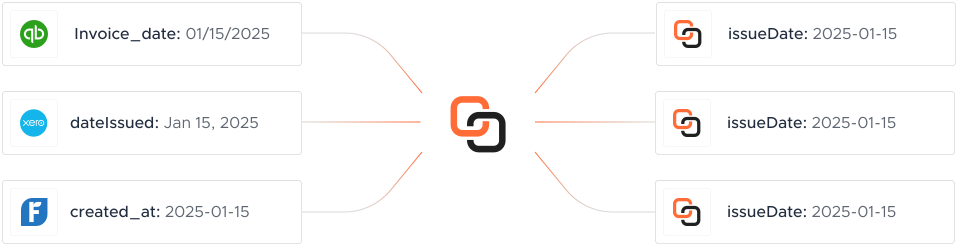
Each Accounting platform exposes its own API, auth, and schema. A Knit MCP Server wraps that platform's real actions as AI-ready tools your agent can call directly — actions like Create Accounting Account, Create Accounting Contact, Create Accounting Expense work the same way no matter which platform your agent is connected to, while Knit manages hosting, auth, and tool exposure underneath.
Every action below is real and already live — not a roadmap item. Browse the full API reference →
This API endpoint allows the creation of an accounting account. It supports various applications like Xero, Zohobooks, Microsoft Dynamics 365, Sage Intacct, Quickbooks, Netsuite, and Freshbooks. The request requires a JSON body with 'name' and 'category' as mandatory fields. The 'category' can be either 'BANK_ACCOUNT' or 'LEDGER_ACCOUNT'. Additional optional fields include 'type', 'subType', 'accountCode', 'accountNumber', 'description', and 'metaData'. The response returns a success status and the unique 'accountId' of the created account. In case of an error, a descriptive error message is provided.
This API endpoint allows the creation of a new accounting contact. The request requires a POST method to the specified URL with headers indicating 'accept' and 'content-type' as 'application/json'. The request body must include 'name' and 'contactType' as required fields, with optional fields such as 'contactPersonFirstName', 'contactPersonLastName', 'email', 'phoneNumber', 'taxNumber', 'addresses', and 'metaData'. The response will return a success status with a 'contactId' if successful, or an error message if unsuccessful.
The Create Accounting Expense API allows users to create a new expense record in the accounting system. The request requires a transaction date, total amount, and line items as mandatory fields. Optional fields include employee ID, contact ID, company ID, description, currency, and metadata. The response returns a success status and the ID of the created expense if successful, or an error message if the request fails.
The Create Accounting Invoice API allows users to create an invoice or bill in the accounting system. The request requires a JSON body with the type of document (INVOICE or BILL), a contact ID, and at least one line item. Additional optional fields include status, invoice number, issue date, due date, paid on date, currency, exchange rate, description, total amount, total tax, total discount, and metadata. The response returns a success status and the created invoice ID if successful, or an error message if the request fails.
This API endpoint allows the creation of a journal entry with specified details. The request must include headers specifying 'accept' and 'content-type' as 'application/json'. The body of the request requires 'date', 'lineItems', and 'description' as mandatory fields. 'lineItems' is an array of objects, each containing 'accountId', 'amount', 'notes', 'transactionType', 'contactType', and 'contactId'. Optional fields include 'currency', 'referenceNumber', and 'metaData'. The response returns a success status and a 'journalId' if successful, or an error message if unsuccessful.
This API endpoint allows the creation of a payment in the accounting system. It supports various applications such as Xero, Zohobooks, Microsoft Dynamics 365, Sage Intacct, Quickbooks, Netsuite, and Freshbooks. The request requires headers specifying 'accept' and 'content-type' as 'application/json'. The body must include 'accountId', 'contactId', 'amount', 'invoiceId', 'paymentLinkedTo', and 'linkedInvoices'. Optional fields include 'date', 'description', 'currency', 'exchangeRate', and 'metaData'. The response returns a success status and the 'paymentId' if successful, or an error message if failed.
The Get Accounting Items API allows customers to retrieve records of products and services they buy and sell. It supports various applications such as Xero, Zohobooks, Microsoft Dynamics 365, Quickbooks, Netsuite, and Freshbooks. The API accepts a query parameter 'itemId' to fetch details of a specific item. The response includes details such as item ID, name, code, type, creation and update timestamps, status, description, total quantity, unit price, sales details, and purchase details. In case of an error, a descriptive error message is returned.
This API endpoint allows you to retrieve basic information about companies related to your accounting app. It supports various apps such as Xero, Zohobooks, Microsoft Dynamics 365, Quickbooks, Freshbooks, and Netsuite. The request is made using the GET method and requires an 'accept' header with 'application/json'. You can optionally provide a 'companyId' as a query parameter to fetch details for a specific company. The response includes a success flag and data containing an array of company details such as id, name, legal name, tax number, fiscal year start month and day, creation date, active status, currency, URLs, addresses, phone numbers, and contact information.
This API endpoint retrieves tax rates from an accounting application. It supports various apps such as Xero, Zohobooks, Microsoft Dynamics 365, Sage Intacct, Quickbooks, Netsuite, and Freshbooks. The API method is GET, and it requires an 'accept' header with 'application/json'. Optionally, a 'taxRateId' can be provided as a query parameter to fetch details of a specific tax rate. The response includes a success flag, and if successful, a list of tax rates with details such as id, name, code, type, creation and update timestamps, status, description, effective and total tax rates, and components. In case of an error, an error message is returned.
This API endpoint retrieves tracking categories used for financial reporting purposes. It supports various applications such as Xero, Microsoft Dynamics 365, Quickbooks, Netsuite, and Freshbooks. The request requires an 'accept' header with 'application/json' and optionally a 'categoryId' query parameter to specify a particular tracking category. The response includes a success flag and data containing an array of tracking categories with details such as id, name, creation and update timestamps, category type, status, description, and parent category information.
The Update Accounting Account API allows users to update details of an existing accounting account. The API requires the accountId and category as mandatory fields in the request body. The category can be either BANK_ACCOUNT or LEDGER_ACCOUNT. The API supports various accounting applications such as Xero, Zohobooks, Microsoft Dynamics 365, Sage Intacct, Quickbooks, Netsuite, and Freshbooks. The response indicates whether the update was successful or not, and in case of an error, a descriptive message is provided.
The Update Accounting Contact API allows users to update contact information in supported accounting applications such as Xero, Zohobooks, Microsoft Dynamics 365, Sage Intacct, Quickbooks, Netsuite, and Freshbooks. The API requires a POST request with headers specifying 'accept' and 'content-type' as 'application/json'. The request body must include 'name', 'contactType', and 'contactId' as required fields, along with optional fields such as 'contactPersonFirstName', 'contactPersonLastName', 'email', 'phoneNumber', 'taxNumber', 'addresses', and 'metaData'. The response will indicate success with a boolean and may include additional data or an error message if applicable.
The Update Accounting Invoice API allows users to update an existing invoice in various supported applications such as Xero, Zohobooks, Microsoft Dynamics 365, Sage Intacct, Quickbooks, Netsuite, and Freshbooks. The API requires a POST request with headers specifying 'accept' and 'content-type' as 'application/json'. The request body must include 'type', 'invoiceId', 'contactId', and 'lineItems'. Additional optional fields include 'invoiceNumber', 'status', 'issueDate', 'dueDate', 'paidOnDate', 'currency', 'exchangeRate', 'description', 'totalAmount', 'totalTax', 'totalDiscount', and 'metaData'. The response will indicate success or failure, with a success response containing a 'success' boolean and a failure response containing an 'error' object with a descriptive message.
The Update Payment Details API allows updating payment information linked to invoices or bills. It requires parameters such as paymentId, accountId, contactId, amount, invoiceId, and paymentLinkedTo. Optional fields include date, description, currency, exchangeRate, linkedInvoices, and metaData. The response indicates success or failure with an optional error message.
Our AI Agent builds it instantly.
Try Now


Connect your AR/AP automation platform to QuickBooks, Xero, NetSuite, Sage, and 12+ accounting and ERP systems. Enable your customers to…
Explore this use case

Connect your FP&A platform to Oracle, SAP, Microsoft Dynamics, and 100+ ERPs and data sources. Enable finance teams to build…
Explore this use casePull credit scores/KYC data, import borrower bank statements, and push repayment schedules into accounting alongside chart-of-accounts and AP/AR sync.
Explore this use case
Knit's FreshBooks MCP Server gives your AI agents instant, code-free access to every FreshBooks API endpoint-read, write, and automate without OAuth headaches or custom endpoints.
Knit's Odoo MCP Server gives your AI agents instant, code-free access to every FreshBooks API endpoint-read, write, and automate without Auth headaches or custom endpoints.
Knit's QuickBooks MCP Server gives your AI agents instant, code-free access to every QuickBooks API endpoint-read, write, and automate without OAuth headaches or custom endpoints.
Knit's Xero MCP Server gives your AI agents instant, code-free access to every Xero API endpoint-read, write, and automate without OAuth headaches or custom endpoints.
Knit's Zoho Books MCP Server gives your AI agents instant, code-free access to every Zoho Books API endpoint-read, write, and automate without OAuth headaches or custom endpoints.
Describe it to our AI Integrations Agent and get a working integration instantly — no waiting on our roadmap.
Meet the Integrations AgentEvery Accounting MCP Server spins up with zero infrastructure — Knit scales, patches, and monitors it for you.
OAuth, SAML, service accounts — Knit manages credentials and refreshes across every Accounting platform.
AI-powered connector building means a missing Accounting platform isn't a months-long wait.
See how leading technology firms are scaling their operations
Amazing Product With Exceptional Support from the team. By using Knit we managed to speed up our development by orders of magnitude.
A brilliant tool to let you seamlessly integrate with many different systems. It is very easy to integrate with and customer support is next level.

Seamless integration experience. Well-documented, self-explanatory APIs, and excellent service and support.
Easy to integrate. Knit's dashboard is intuitive for setting up and testing integrations, and the sandbox is extremely useful during development.
Knit shipped a brand-new Timesheet API in a week and handed us a ready-to-use NetSuite sandbox. That velocity is priceless when you're running payroll in 40+ countries.

4.9 out of 5 stars on G2



5 Accounting platforms today — including FreshBooks, Odoo, QuickBooks and more. Missing one you need? Knit's AI-assisted connector-build process typically adds a new one within days.
Yes. Every action can both read and write, so your agent can pull Accounting data and push updates back to the source app, not just query it.
Knit manages OAuth, credential storage, and refresh for every Accounting platform — your team never wrestles with tokens, and there's nothing to configure per platform.
Typically days, not months — the same AI-based connector-build tooling that lets us maintain the 5 Accounting mcp servers already live.
No. Knit acts as a stateless passthrough — data is processed on our application server and returned directly to your agent, without being stored on Knit's servers.
You choose the model that fits your business — pricing based on integrated accounts, or based on API call volume. Every plan includes a 30-day free trial before billing starts.
This directory is a live list of all Accounting API integration guides we have written at Knit. Use it to quickly find the guide related to the specific Accounting APP you want to learn more about.
A practical 2026 guide for developers building accounting API integrations — covers QuickBooks, Xero, NetSuite, Sage, and more. Includes data models, auth patterns, common challenges, and how a unified accounting API like Knit cuts integration time from months to days.
Learn about the common FreshBooks API data models and API end points in this comprehensive FreshBooks API directory